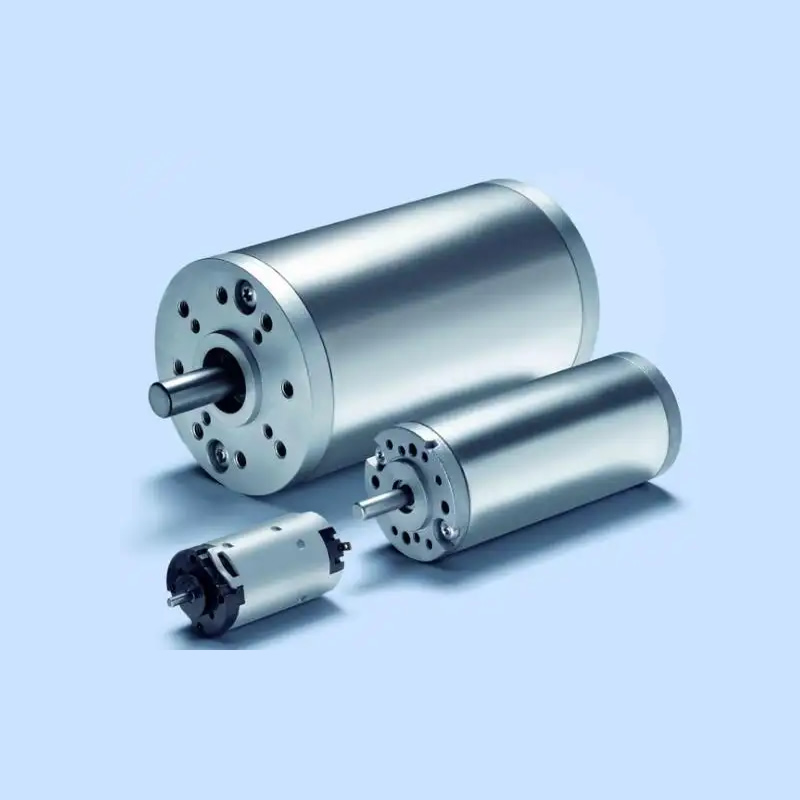
The MOSFET solution for self-excited motors is designed for the unique architecture of excitation and armature winding self coupling, focusing on three core requirements: reliable self starting voltage building, wide speed range, and high integration without dual power supply. It covers the drive control of all types of self-excited motors, including series excitation, parallel excitation, and compound excitation, and is suitable for heavy-duty scenarios such as electric forklifts, industrial traction, and electric tools.
Core Drive Link Scenario Device Solution1. Main H-bridge drive link of series excited motorAs the mainstream power solution for electric forklifts and tractors, the core requirements are high starting torque and resistance to stalling impact:
High power overload solution: Curtis 1244 controller is equipped with MOSFET power range, supporting 24-80V wide voltage input, armature rated current covers 400-700A, advanced MOSFET power level achieves conversion efficiency of over 98%, and significantly reduces operating noise
Mainstream industrial solution: Infineon TLE4976-1K, 40V/209A, Rds (on) as low as 1.25m Ω under SGT process, TOLL package parasitic inductance extremely low, suitable for industrial traction series excited motors under 5kW, device temperature rise controlled within 30K under locked rotor conditions
High voltage power grid adaptation solution: VBPB18R47S, 800V/47A, TO-3P package, 90m Ω extremely low on resistance, compatible with 220V/380V industrial busbar, directly drives high-power lifting equipment series excited motor
2. Speed control link of parallel/compound excitation motorThe core requirement is the coordinated voltage regulation of excitation and armature to achieve smooth and wide range speed regulation:
Precise speed control solution: Curtis 1268 SepEx ® Controller architecture, using MOSFET combination with half bridge armature and full bridge excitation, supporting full energy feedback braking at zero speed, IP64/IP67 sealed housing suitable for harsh industrial environments
Mainstream adaptation solution: VBM1606, 60V/120A, TO-220 package, Rds (on) of only 4m Ω under SGT technology, gate charge Qg of only 47nC, supporting 20kHz high-frequency PWM, suitable for conventional parallel excited servo motors under 3kW
Excitation bootstrap scheme: TI PMP22992 reference design, using LMR50410-Q1 pre stabilized SN6505-Q1 transformer drive to generate dual isolated 15V bias power supply, providing stable driving power supply for the excitation circuit of self-excited synchronous motor
3. Energy feedback and braking protection linkThe core requirements are bidirectional current carrying capacity, low body diode recovery loss, and efficient energy recharge during deceleration process:
Feedback preferred solution: Ansenmei FDP036N10A, 100V/120A, TO-220 package, 3.2m Ω low on resistance, conduction loss of only 18W at 75A current, excellent soft recovery characteristics of body diode, energy feedback efficiency improved to over 92%
Emergency braking plan: VBL2603, -60V/-130A, P-channel Trench process, Rds (on) as low as 3m Ω, sufficient redundancy for high current on/off capability, ensuring millisecond level activation of the energy consuming braking circuit and achieving rapid shutdown

 17374646018




 Follow
 17374646018
 E-mail
